What Are the Pipes Under My Combi Boiler? Each One Explained
Quick answer
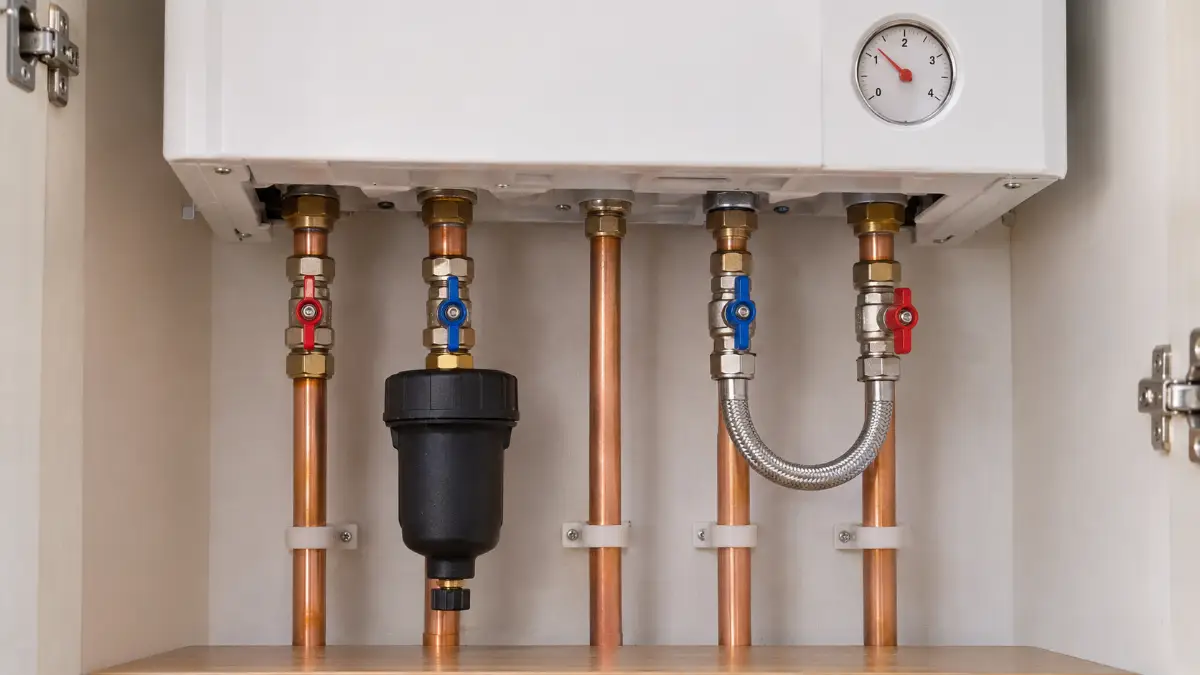
Most combi boilers have five main pipes underneath: the gas supply, the central heating flow and return, the mains cold water in and the hot water out. You will usually also see a pressure relief discharge pipe, a plastic condensate pipe, a filling loop and often a magnetic system filter. The only parts most homeowners should ever touch are the filling loop or filling key, used exactly as the boiler manual explains. Leave everything else to an engineer.
- Never adjust or undo the gas pipe or its valve. If you smell gas, turn the supply off at the meter and call 0800 111 999.
- The copper pipe that runs outside from the pressure relief valve should only release water when pressure gets too high.
- The white plastic condensate pipe drips while the boiler runs. That is normal.
- An external filling loop hose should be disconnected after use.
Open the cupboard under a combi boiler and you will find a cluster of pipes, valves and sometimes a round canister. Knowing what each one does helps you describe a problem clearly when you call an engineer, top up the pressure safely and tell a normal drip from a fault. This guide goes through each pipe you are likely to see under a gas combi, what it is for and which ones you can safely touch.
Layouts vary between makes and models, and an installer may have added valves or a filter of their own. Your boiler’s user manual has a diagram of the connections for your model, so keep it to hand as you read.
Before you touch anything
Work on a gas boiler should be left to a suitably qualified Gas Safe registered engineer. That includes the gas pipe, the gas valve under the boiler and anything inside the casing. The Health and Safety Executive says it is illegal to use a gas appliance you suspect is unsafe, and that you should turn it off and not touch it until a Gas Safe registered engineer has checked it.
If you smell gas, the HSE’s advice is to shut the supply off at the meter control valve if you know where it is, open doors and windows, and call the National Gas Emergency Service on 0800 111 999. The meter control valve is not one of the pipes under your boiler. It is the lever next to your gas meter.
The pipes under a typical combi at a glance
| Pipe or part | What it does | Can you touch it? |
|---|---|---|
| Gas supply | Brings gas to the boiler | No |
| Central heating flow | Carries hot water out to the radiators | No |
| Central heating return | Brings cooler water back from the radiators | No |
| Mains cold water in | Feeds cold mains water into the boiler to be heated for taps and showers | Only to isolate in a leak, if the manual shows how |
| Hot water out | Carries heated water to your taps and showers | No |
| Pressure relief discharge pipe | Lets water out safely if heating pressure gets too high | No |
| Condensate pipe | Drains slightly acidic waste water from the boiler | Outside, only to thaw it with warm water |
| Filling loop or filling key | Lets mains water into the heating to top up the pressure | Yes, following the manual |
| Magnetic system filter | Catches sludge before it reaches the boiler | No, leave it for the annual service |
Each pipe explained
Gas supply pipe
This brings gas from your meter to the boiler. There is usually a valve on it under the boiler so an engineer can isolate the gas to the appliance while they work. Leave both the pipe and the valve alone. If you think the boiler is unsafe or you can smell gas, follow the steps above rather than trying to turn the gas off at the boiler.
Central heating flow and return
A combi heats water for your radiators in a sealed loop. The flow pipe carries heated water out to the radiators, and the return pipe brings it back to the boiler to be heated again. Worcester Bosch’s installation manuals label them “CH flow” and “CH return”. On the older Greenstar combi shown in one of its manuals, both are 22mm pipes, while the hot and cold water pipes are 15mm. Sizes vary by model, so check your own manual.
These pipes usually have isolating valves so an engineer can work on the boiler without draining every radiator. They are not for everyday use. Sludge building up in this loop is a common reason for cold spots, and our guide to power flushing explains when cleaning it helps.
Mains cold water in
A combi heats your hot water straight from the mains, so it has its own cold mains connection. Water enters cold and leaves hot only when you turn on a tap or shower. If your hot water pressure seems poor, the cause is often the mains supply or a partly closed valve rather than the boiler, and our guide to low hot water pressure covers the checks to try.
In a leak, Glow-worm’s advice is to contain the water and, if you cannot, turn off the mains cold water at the stop tap and switch off the electricity supply to the boiler. If you are not sure where yours is, see our guide to finding your stopcock.
Hot water out
This carries hot water from the boiler to your taps and showers. It runs alongside the cold mains pipe and is usually the same size. It gets hot when a hot tap is running, so take care if you are looking for a leak.
Pressure relief valve discharge pipe
The pressure relief valve is a safety device inside or under the boiler. Baxi’s installation manual says its valve is set at 3 bar. If the heating pressure climbs too high, the valve opens and lets water out through a discharge pipe, then closes again once the pressure drops.
The discharge pipe is usually copper and runs through the wall to the outside. Vaillant says it will end on the outside wall or turn down towards the ground. An occasional release is the valve doing its job. A constant drip means the boiler keeps reaching high pressure, and Glow-worm says it can mean the valve has failed or the expansion vessel needs replacing. Vaillant says it is not safe to try to fix this yourself.
Ask an engineer to look at a pressure relief valve that keeps discharging. Our boiler repair service covers valve and expansion vessel faults.
Condensate pipe
Modern condensing boilers make waste water as they recover heat from the flue gases. Worcester Bosch says the condensate pipe is normally plastic and runs to a household drain or soakaway outside. Worcester also describes the water as slightly acidic, which is why the pipe is plastic rather than copper. Its technical guidance says a condensing boiler can produce 2 to 3 litres of condensate an hour while it is running, so water dripping from this pipe is normal.
The one job you can do on this pipe is thaw it in a freeze. If it freezes, the boiler stops and may show a fault code. Worcester’s advice is to pour warm, not boiling, water along the outside section if it is safe to do so, then reset the boiler. Our guide to a frozen condensate pipe goes through it step by step.
Filling loop or filling key
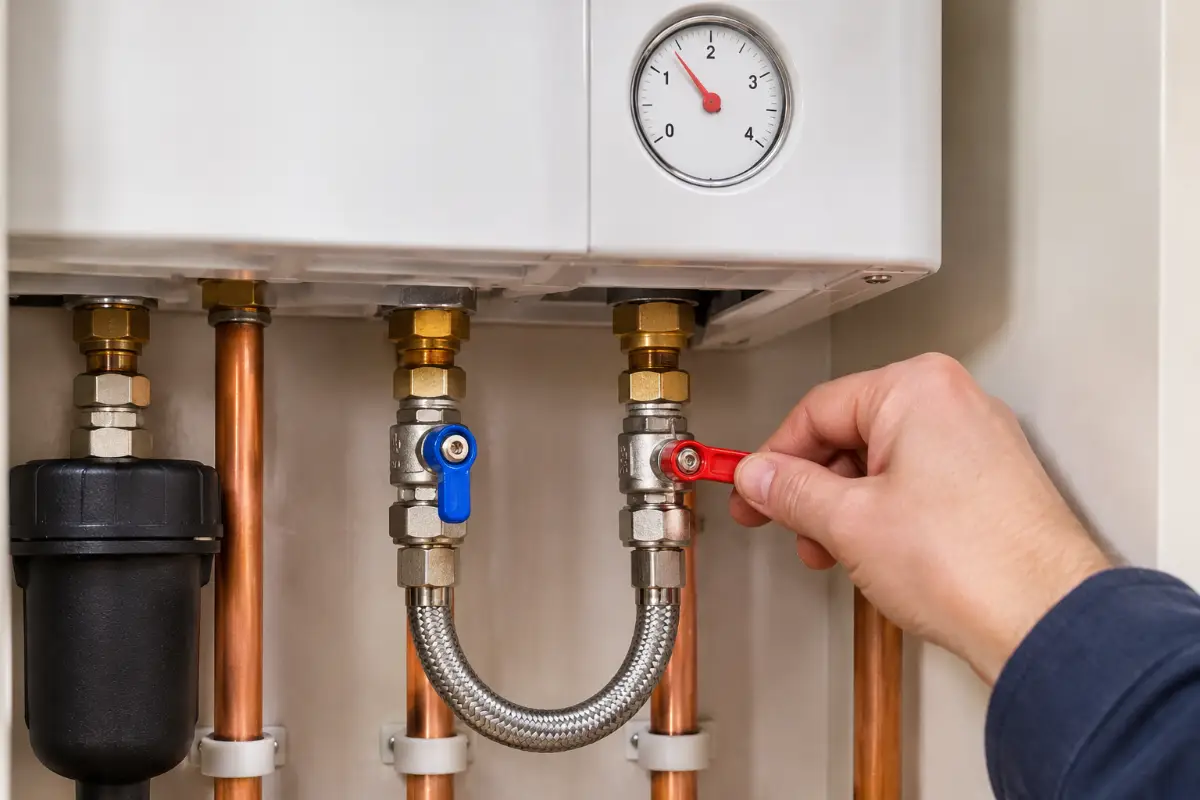
Because the heating side is a sealed loop, it slowly loses pressure over time and sometimes needs topping up from the mains. That is what the filling loop is for. You will find one of three types:
- An external filling loop: a short braided hose with a valve at each end, linking the cold mains to the heating pipework under the boiler.
- An internal filling key: on some Worcester Bosch combis, a removable key that slots into the underside of the boiler.
- A keyless filling link: on some Worcester Bosch models, a blue lever under the boiler that you pull down to let water in.
This is the part homeowners are expected to use. How to do it is covered below, and our guide to a boiler losing pressure explains what to do if you keep having to top it up.
Magnetic system filter
Many boilers now have a round or cylindrical filter on the return pipe just below the boiler. Baxi describes it as a small device fitted close to where water goes back into the boiler. It uses a magnet to catch rust particles and other magnetic debris, known as magnetite or sludge, before they can damage or block the boiler. Worcester Bosch’s own system filter also catches non-magnetic debris.
Baxi recommends having the filter cleaned at your annual service. It also states that repairs needed because of sludge are not covered by its warranties. Ask your engineer to clean the filter as part of your boiler service rather than opening it yourself, as it holds system water under pressure.
Which ones can you safely touch?
For most people, the list is short:
- The filling loop or filling key, to top up the pressure, exactly as your boiler’s manual describes.
- The outside section of the condensate pipe, to thaw it with warm water in freezing weather.
- The stop tap, to turn off the cold mains in a leak.
Leave the gas pipe and its valve, the pressure relief valve, the heating isolating valves, the filter and anything inside the casing to an engineer. If a manual shows a homeowner step that is not on this list, follow the manual for your model.
How to top up the pressure with a filling loop
Vaillant’s guide for a boiler with an external filling loop runs roughly like this:
- Switch the boiler off and let the system cool.
- Check the filling loop hose is attached securely at both ends.
- Open the valves slowly so mains water flows into the system.
- Watch the pressure gauge and stop at the level your manual recommends, usually around 1 to 1.5 bar.
- Close both valves.
- Switch the boiler back on and check it is working normally.
Worcester Bosch boilers with a keyless filling link work differently: you pull the blue lever down and release it once the pressure goes just over 1 bar. Those with an internal key need the key fitting and turning, so follow the manual for your model.
An external filling loop links your drinking water supply to the heating water, so the hose should not stay connected. Water Regs UK says the connecting loop should only be connected when the system needs topping up, and removed straight after use. If your hose is permanently connected, ask your engineer about it at the next service.
If you need to top up more than occasionally, the system is losing water somewhere. Vaillant advises against repeatedly repressurising if the pressure drops again straight away, and recommends calling an engineer.
Water dripping outside: which pipe is it?
Two pipes from a combi usually come through the outside wall, and they mean very different things:
- A white or grey plastic pipe running to a drain or down into the ground is normally the condensate pipe. Dripping while the boiler is running is normal.
- A copper pipe ending on the wall or turned down towards the ground is normally the pressure relief discharge pipe. It should be dry most of the time, so a regular drip is worth getting checked.
If you are not sure which is which, check the boiler pressure gauge. Glow-worm says a reading above 2 bar when the system is warm is higher than normal.
Water leaking under the boiler
Glow-worm’s advice for a leak under the boiler is to find where the water is coming from, look for damp patches or corrosion, and contain the water with a bucket or towels. Leaks from joints are more likely soon after a new installation, so contact your installer first if the boiler is new. If you cannot contain the leak, turn off the mains cold water at the stop tap and switch off the electricity to the boiler. Glow-worm says not to try to repair a leak yourself, because only an engineer can check inside the boiler.
A leaking joint or pipe near the boiler is a heating repair, and leaks elsewhere in the house may be a job for our plumbing service.
When the pipes point to a bigger job
Corroded pipework, repeated pressure loss or a boiler that keeps locking out can be signs of an ageing system. If your engineer suggests replacing the boiler, our page on new boiler installation explains what a replacement involves.
Frequently asked questions
Which pipe under my boiler is the gas pipe?
It depends on the model, so check the connection diagram in your boiler manual. Whichever it is, do not adjust or undo it. If you smell gas, turn the supply off at the meter control valve and call 0800 111 999.
Is it normal for the plastic pipe outside to drip?
Yes. A condensing boiler produces waste water whenever it runs, and the condensate pipe carries it to a drain. Worcester Bosch says a boiler can produce 2 to 3 litres an hour while running.
Why is the copper pipe outside dripping?
That is usually the pressure relief discharge pipe. It drips when the heating pressure is too high, or when the valve or expansion vessel has a fault. Check the pressure gauge and ask an engineer to investigate if it keeps happening.
Can I leave the filling loop connected?
No. An external filling loop hose should be disconnected after you have topped up the pressure, so the heating water cannot get back into the drinking water supply.
Do I need a magnetic filter?
A filter is often fitted with a new boiler, and Which? Trusted Traders notes that some manufacturers extend the boiler warranty when one is installed. It is not a part you should open yourself. Ask your engineer whether your system has one and to clean it at the annual service.
Need help with your boiler?
If something under your boiler is leaking, dripping or losing pressure, tell us what you can see and where you are in Greater Manchester. You can request a free, no-obligation quote, and you should get a clear price before any work starts.
Sources
This guide is based on the following published advice and manufacturers’ manuals, checked in November 2026.
- HSE: Domestic gas, frequently asked questions
- HSE: Gas safety, home owners
- Worcester Bosch: Greenstar installation and servicing instructions
- Worcester Bosch: Boiler pressure
- Worcester Bosch: Frozen condensate
- Worcester Bosch: Quick guide to condensate
- Worcester Bosch: Technical bulletin on frozen condensate
- Worcester Bosch: Greenstar system filter
- Vaillant: What does a pressure relief valve do?
- Vaillant: How to repressurise a boiler
- Baxi: What is a magnetic boiler filter?
- Baxi 24 Combi installation manual: pressure relief valve
- Glow-worm: Is your boiler leaking? What to check
- Which? Trusted Traders: What is a magnetic filter?
- Water Regs UK: Filling loop installation requirements