Power Flush: What It Is, When It Helps and What It Costs
Quick answer
A power flush uses a pumping unit to drive water and cleaning chemicals through your radiators, pipes and boiler to clear sludge. It can help where sludge is restricting circulation, but it won’t fix a leak or a failed part, and it isn’t always the right cleaning method.
- Possible signs: radiators cold at the bottom, black water when bled, slow or uneven heating.
- Typical UK cost: £350 to £800 before VAT, depending on the number of radiators.
- Typical time: several hours to a full day, longer on larger systems.
- New boiler: the system should be cleaned, but that may be a mains flush rather than a full power flush.
- Older systems: ask the engineer to check for weak radiators and faults first.
If your radiators have cold patches or the water runs black when you bleed them, you may be told your heating needs a power flush. It can make a real difference to a system clogged with sludge, but it isn’t the answer to every heating problem. This guide explains what a power flush involves, the signs that point towards one, when it won’t help, what it typically costs and which questions to ask before you agree to it.
What is a power flush?
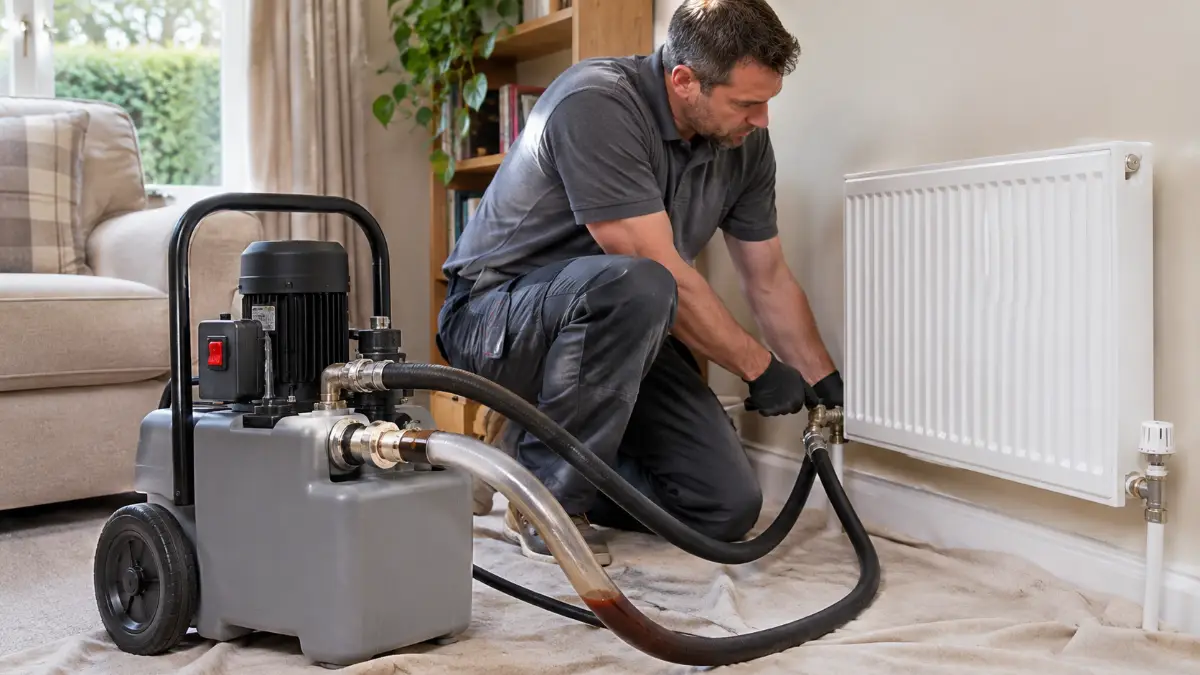
A power flush is a deep clean of the water side of a wet central heating system: the radiators, the pipework and the boiler’s heating circuit. An engineer connects a pumping unit to the system and pushes water through it at high velocity, often with a cleaning chemical, to loosen sludge, rust and debris and carry it out to waste. Which? Trusted Traders describes the job as flushing in both directions, working on stubborn radiators, neutralising the chemical and then adding inhibitor.
Sludge largely comes from corrosion inside the system. It settles where the water moves slowest, which is why the bottom of a radiator often goes cold first. It can also restrict the narrow waterways inside a boiler.
A power flush is one of several ways to clean a system. Others are covered further down, because the most powerful option isn’t always the one you need.
Signs your heating may need a power flush
These signs can point to sludge, drawing on the lists from Which? Trusted Traders and HomeServe:
- Radiators that are warm at the top and cold at the bottom, or have cold patches
- Radiators that are cold while the pipes feeding them are hot
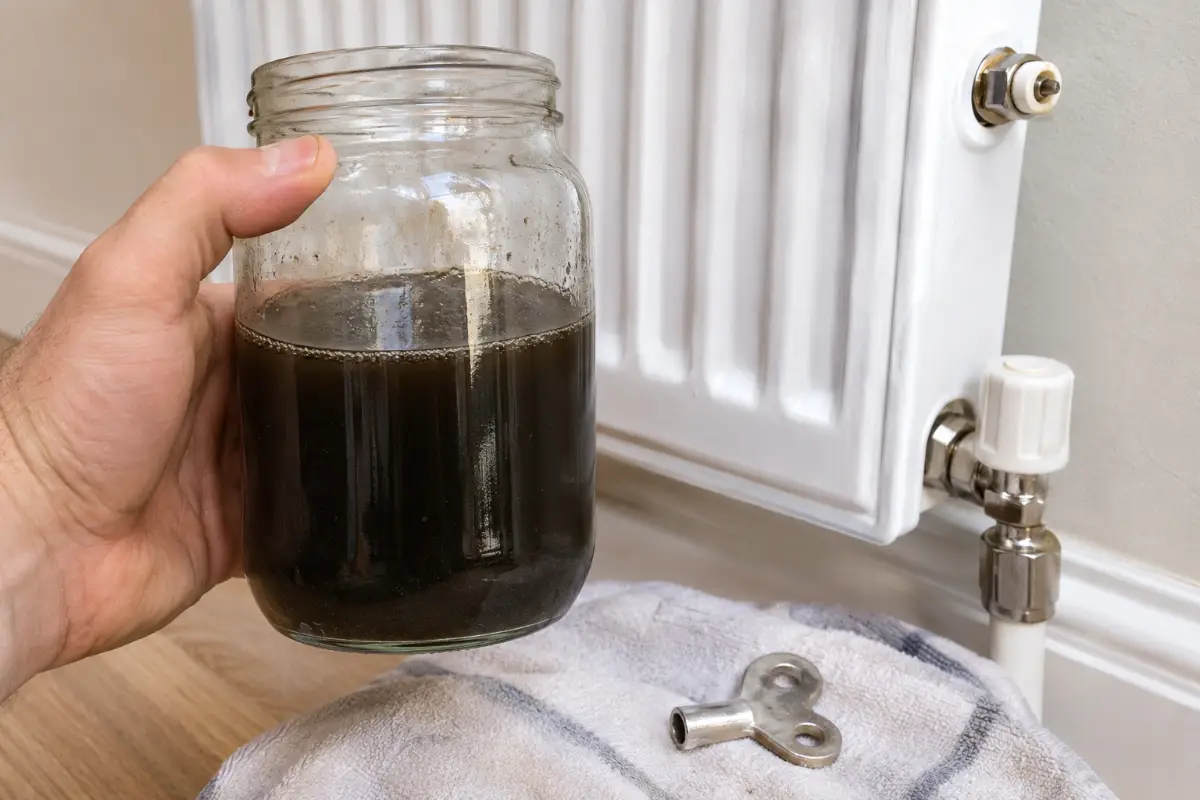
- Brown or black water when a radiator is bled
- Radiators that need bleeding again and again
- Some radiators heating far more slowly than others
- Noises from the boiler or pipes
- Repeated boiler breakdowns or restarts
- A magnet sticking to copper pipework, which can indicate iron sludge inside
None of these proves that a power flush is needed. Each one can have another cause, so it’s one of the first things to check rather than a diagnosis. Our guide to radiators that are cold at the top or bottom explains how to tell trapped air from sludge.
A noisy system has its own list of possible causes, which our guide to what boiler noises mean works through.
When a power flush won’t help
Which? Trusted Traders is clear that a flush has limits. It won’t repair parts that have already failed, such as valves damaged by sludge, and it won’t cure pressure loss, which usually points to a leak. If your gauge keeps dropping, start with our guide to why a boiler loses pressure.
A flush also isn’t likely to help if the real problem is a faulty pump, a stuck valve, an unbalanced system or a failing boiler part. Paying for a clean first could mean paying for the repair as well, so ask the engineer to look for underlying faults before you commit. Where a fault is the likelier explanation, boiler repairs may be the better place to start.
Age matters too. Which? Trusted Traders says a flush removes a good proportion of sludge but not all of it, can be less effective on heavily silted systems and may not suit systems of 15 years or more. It also notes that replacing an older system can sometimes be more cost-effective.
Power flush, mains flush or chemical clean?
BS 7593, the code of practice for treating water in domestic heating systems, recognises powerflushing, mains-pressure cleaning and gravity cleaning, as Fernox’s summary of the standard sets out. Heating trade guidance from the Heat Pump Association and HHIC also lists online cleaning, and says that isolating and flushing radiators one at a time gives the most thorough result.
| Method | How it works | Often considered for |
|---|---|---|
| Power flush | A pumping unit drives water and cleaning chemical through the system at high velocity | Systems with clear signs of heavy sludge |
| Mains-pressure flush | Mains water is used to flush the system through, usually with a cleaner added first | Lighter contamination, or cleaning a system when a boiler is replaced |
| Gravity or chemical clean | A cleaner circulates using the system’s own pump, then the system is drained, refilled and dosed | Newer systems in good condition, or where a high-velocity flush isn’t suitable |
| Online clean with a filter | A cleaner circulates with the heating running, and loosened debris collects in a filter | Lighter contamination |
The right method depends on how dirty the system is, what it’s made of and how it’s laid out. Ask the engineer to explain why they’re recommending one method over another.
What happens during a power flush?
The exact steps vary between engineers and machines, but a typical job looks like this:
- The engineer checks the system for weak radiators, leaks and faulty valves
- The pumping unit is connected, often at the circulating pump or a radiator
- A cleaning chemical is added and the flow is reversed at intervals to loosen deposits
- Radiators are flushed in turn, and stubborn ones may be agitated with a vibrating pad
- Dirty water is sent to waste until it runs clear and a chemical neutraliser is used
- Water quality is checked and inhibitor is added to protect the system
Which? Trusted Traders says the job typically takes several hours to a full day. HomeServe says up to about eight hours, and up to two days on complicated systems.
If you have a combi, Which? Trusted Traders suggests asking whether the plate heat exchanger that heats your hot water will be flushed separately.
Can a power flush cause leaks?
Sources differ on this. Which? Trusted Traders warns that high-speed water can stress weak areas, such as rusting radiators, and cause leaks. Heatable argues that flushing runs at high velocity but low pressure, and that it’s more a case of dislodged debris exposing a leak that already existed. Either way, the practical advice is the same: a leak can appear during or soon after a flush, so the system should be inspected first and you should agree beforehand what happens if one does.
Heatable also notes that microbore systems, with their narrow pipes of around 8mm, can be harder to flush and that a chemical clean is generally advised first. If your home has microbore pipework, mention it when you ask for a quote.
How much does a power flush cost?
A power flush typically costs £350 to £800 across the UK, depending mainly on the number of radiators. These are typical 2026 UK price ranges, based on Checkatrade’s cost guide, which describes its figures as ballpark averages and lists them before VAT.
| Property | Radiators | Typical cost | Typical time |
|---|---|---|---|
| 2-bed flat | 4 | £350 | 1 day |
| 2-bed house | 6 | £450 | 1 day |
| 3-bed house | 10 | £550 | 1 day |
| 4-bed house | 15 | £800 | 1 to 2 days |
Your quote may also depend on access, how contaminated the system is and whether extras are needed, such as a magnetic filter, repairs or a replacement radiator. Ask whether the price includes VAT, chemicals and inhibitor, and agree a written price with the engineer before any work starts.
Do you need a power flush with a new boiler?
You need the system cleaned, but that doesn’t automatically mean a full power flush. Baxi’s summary of the Building Regulations says the system should be cleansed and flushed when a new boiler is installed in England, with inhibitor added and an in-line filter fitted. Worcester Bosch says it’s best practice to cleanse an existing system before the new boiler goes in and that BS 7593 should be followed.
Which? Trusted Traders notes that the clean may be a mains-water flush rather than a full power flush. When you compare quotes for new boiler installation, check which method each installer has included, as one price may cover a basic flush and another a full power flush.
Warranty terms can depend on this as well. Some manufacturers make it a condition: Intergas’s warranty terms, for example, require the system to be flushed to BS 7593. Keep the paperwork and check the terms for your boiler. Our guide to new boiler costs covers what else can affect the price.
How often does a heating system need flushing?
You’ll see “every five to six years” quoted in some guides, including Ideal Home, but that’s a rule of thumb. A well-treated system may not need one on a timetable. The HPA and HHIC guidance focuses on testing inhibitor levels each year and topping up as needed, then fully re-dosing or sending a sample for laboratory testing every five years.
Ask whether inhibitor is checked and any magnetic filter cleaned at your annual boiler service. Both help to slow the build-up of new sludge.
Can you power flush a system yourself?
It isn’t a sensible DIY job. It needs specialist equipment and careful handling of chemicals and dirty water, and poor workmanship can leave a system worse off. HomeServe says Gas Safe registration isn’t a legal requirement for the flush itself. However, work on a gas boiler should be left to a suitably qualified Gas Safe registered engineer, so it makes sense to use someone who can also deal with any boiler fault the flush uncovers.
What you can safely do is bleed a radiator, as long as you follow the instructions for your system, and note what colour the water is. That information helps the engineer decide what’s needed.
Power flushing in Greater Manchester homes
Greater Manchester’s housing runs from Victorian terraces to post-war semis and modern flats, so heating systems vary a lot in age and layout. Older systems may have radiators that have been in place for decades, and some homes may have microbore pipework or a feed tank in the loft. Those details are worth telling the engineer about, because they can affect which cleaning method is suitable and whether replacing a tired radiator makes more sense than cleaning it.
If you rent, report poor heating to your landlord rather than arranging a flush yourself.
Questions to ask before you agree to a power flush
- What did you find that points to sludge rather than another fault?
- Would a mains flush or chemical clean do the job?
- Have you checked the radiators and valves for weak spots?
- What happens, and who pays, if a leak appears during the work?
- Does the price include VAT, chemicals, inhibitor and a filter?
- Will you test the water afterwards and show me the result?
- Will I get paperwork recording what was done?
Find out more about power flushing and central heating repairs across Greater Manchester.
A leaking radiator valve or pipe can be a separate job, and plumbing repairs may be all that’s needed there.
If you’d like someone to look at your system, you can request a free, no-obligation quote from a heating engineer covering your area.
Power flush FAQs
Is a power flush worth it?
It can be worth it where sludge is clearly affecting a system that is otherwise sound. It’s less likely to be good value if the system is very old, if the radiators are failing or if the real problem is a faulty part.
Will a power flush fix a cold radiator?
It can if sludge is the cause. A radiator that’s cold at the top is more likely to have trapped air, and a single cold radiator may have a valve problem or need balancing, so those should be checked first.
How long does a power flush take?
Typically several hours to a full day, and sometimes up to two days on a large or complicated system. You’ll usually be without heating while the work is carried out.
Will a power flush lower my energy bills?
Better circulation can help a system heat your home more effectively, but the effect varies and depends on how badly the system was affected. Be wary of any promise of a specific saving.
Should I get a magnetic filter after a power flush?
A filter helps capture debris as it circulates, so it’s worth asking about if you don’t have one. BS 7593 guidance calls for an in-line filter on a new boiler installation in England, and filters should be checked and cleaned at each service.
Can a power flush damage my boiler?
Done properly, it’s intended to protect the boiler. Loosened debris needs to be cleared rather than left circulating, however, which is why the job should finish with clean water, inhibitor and a check of the system.
Sources
Checked in November 2026.
- Which? Trusted Traders: Quick guide to central heating powerflushing
- HomeServe: What is a central heating Powerflush?
- Heatable: What is a power flush?
- Checkatrade: Power flush cost guide
- Ideal Home: How to tell if your heating system needs a power flush
- Fernox: BS 7593:2019, what you need to know
- Heat Pump Association and HHIC: Maintaining a healthy, efficient domestic heating and hot water system
- Baxi: Building Regulations for boiler installation
- Worcester Bosch: Should I have my heating system treated or cleansed?
- Intergas: Warranty terms and conditions