Low Hot Water Pressure: Causes and Fixes
Quick answer
Low hot water pressure has several possible causes, not all of them inside the boiler. One of the first things to check is the cold kitchen tap: if the cold is weak too, the mains supply is the likely area; if the cold is good but the hot is weak, look at the hot water system. The next checks depend on whether you have a combi, gravity-fed or unvented system.
- Make sure the internal stopcock is fully open.
- Clean limescale from shower heads and tap aerators, and check isolation valves are fully open.
- On a combi, hot water flow depends on the incoming mains, so don’t fit a shower pump.
- Gentler flow is normal on gravity-fed systems, where pressure comes from the height of the tank.
- Work on a gas boiler should be left to a suitably qualified Gas Safe registered engineer.
Weak hot water at the taps, or a shower that barely trickles, can have several causes, and they aren’t always inside the boiler. Where to look depends on what kind of hot water system you have: a combi boiler, a gravity-fed (vented) cylinder with a cold water tank in the loft, or an unvented cylinder fed straight from the mains.
This guide explains how to tell which system you have, the simple checks you can make yourself, and when it’s time to call in a heating engineer or plumber.
Pressure or flow: what you’re actually noticing
Most people say “pressure” when they mean how much water comes out of the tap. Worcester Bosch’s installer guidance points out that pressure and flow are not the same thing. A supply can have reasonable pressure but still give a poor flow if the incoming pipe is too small or in poor condition, and the pressure falls once water is actually running.
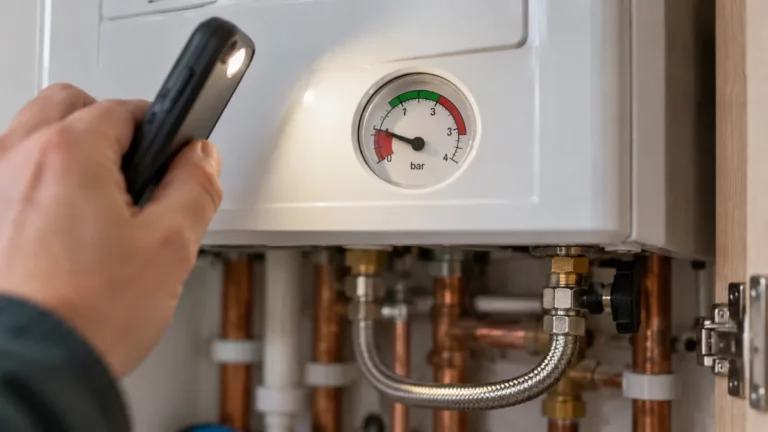
It also helps to know that the pressure gauge on the front of a combi or system boiler shows the pressure of the water in your sealed heating circuit (the radiators). It doesn’t measure the water at your taps. If that gauge is reading low, see our guide to a boiler losing pressure, which is a separate problem.
First, which hot water system do you have?
- Combi boiler: no hot water cylinder and usually no tanks in the loft. Hot water is heated on demand from the cold mains supply.
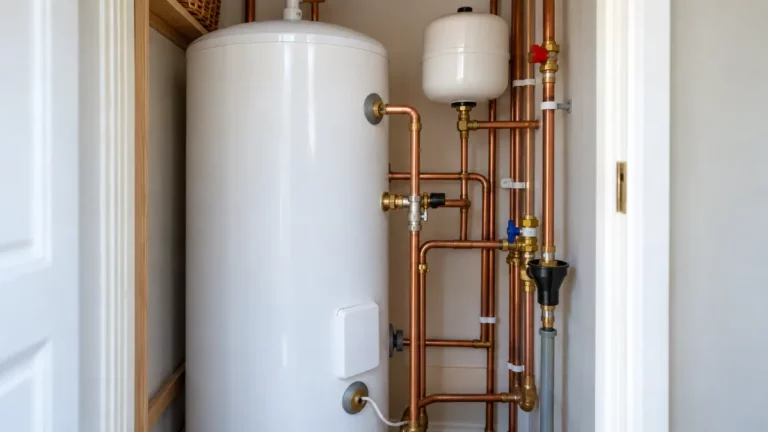
- Gravity-fed (vented) system: a hot water cylinder, often in an airing cupboard, plus a cold water tank (cistern) in the loft. The pressure of your hot water comes from the height of that tank.
- Unvented cylinder: a sealed cylinder fed directly from the mains, with no loft tank, and a set of valves and safety pipework on its cold supply.
Is it just the hot water, or the cold too?
This is the most useful first question. If the cold kitchen tap is also weak, the incoming mains supply is one of the first things to check, rather than the boiler or cylinder. If the cold is fine and only the hot is weak, look at the hot water system itself. If only one tap or shower is affected, start with that outlet.
Checks you can do yourself
1. Make sure the stopcock is fully open
An internal stop tap (stopcock) that has been left partly closed, perhaps after a plumbing job, restricts water to the whole house. United Utilities suggests turning the internal stop tap off and back on four or five times while running the cold kitchen tap. If you’re not sure where yours is, see where is my stopcock?
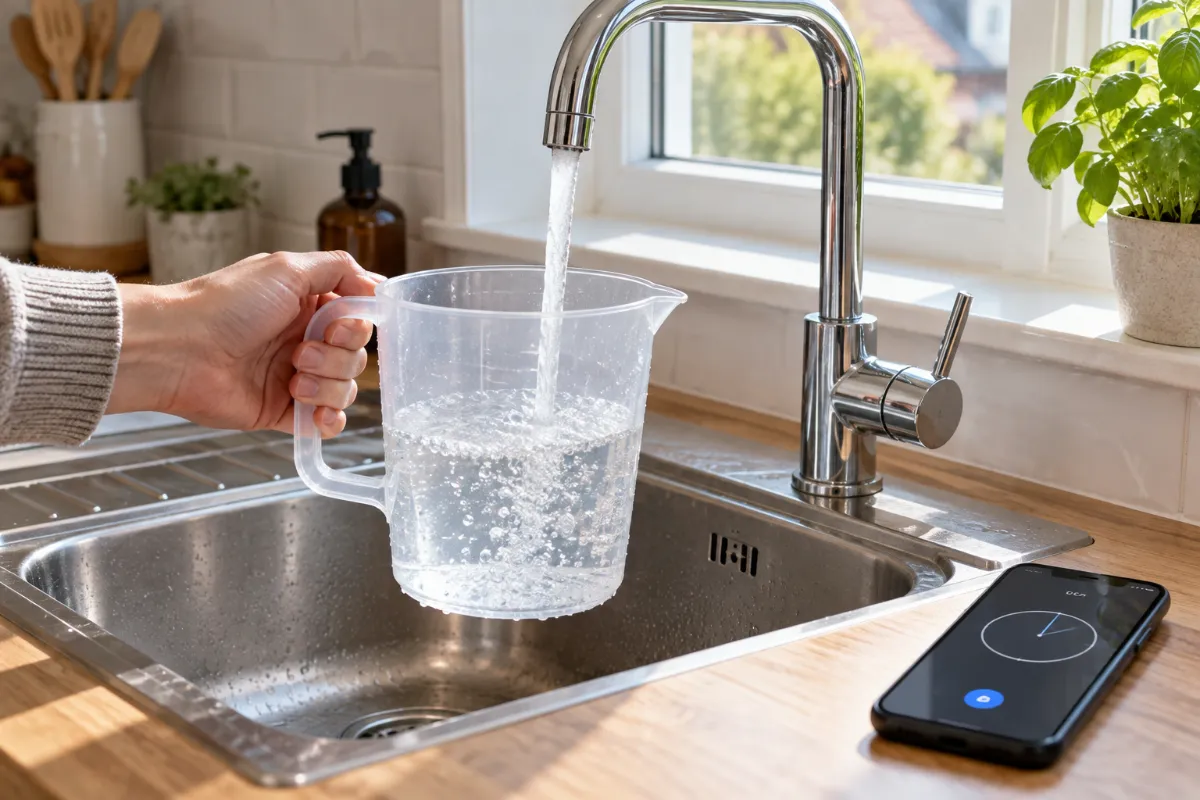
2. Do the jug test on the cold kitchen tap
United Utilities suggests timing how long the cold kitchen tap takes to fill a 1-litre container. If it fills in about 7 seconds or less, the flow meets its service standard. If it takes noticeably longer, the supply into your home may be part of the problem. WaterSafe gives a similar benchmark: with everything else turned off, the first tap in the home should fill a 4.5-litre bucket in 30 seconds.
3. Check the isolation valves
Many taps, showers and appliances have a small isolation valve on the pipe, often with a screw slot you turn with a flat screwdriver. One left half-closed can reduce the flow to a single outlet. Screwfix’s shower guide lists partly closed or faulty valves as a cause of weak showers, including valves hidden behind bath panels.
4. Clean the shower head and tap aerators
Limescale and debris can block the holes in a shower head or the mesh aerator on the end of a tap. Unscrew them, soak them in descaler or vinegar, and brush them clean. Some mixer taps and showers also have small inlet filters that can clog, so check the manufacturer’s instructions before taking these apart.
5. Notice when it happens
United Utilities says pressure can vary at busy times, roughly 7am to 9am and 4pm to 7pm. If your flow is only poor at certain times of day, the cause may be outside your home. The Consumer Council for Water (CCW) suggests keeping a note of when it happens, for example over two weeks, before contacting your water company.
6. Look for leaks
A leak on your supply pipe can reduce pressure. With every tap and appliance turned off, check whether your water meter (if you have one) is still moving, as Viessmann suggests. Damp patches, a dripping overflow pipe or a toilet cistern that keeps refilling are also worth investigating.
Low hot water pressure with a combi boiler
A combi heats water as it passes through, so its hot water can only be as good as the cold mains coming in. Worcester Bosch advises that the water main needs to be large enough to supply hot and cold outlets at the same time. If it isn’t, cold water can be “pinched” from the boiler when another outlet is used, such as a toilet refilling or a washing machine filling. Which? also notes that a combi’s flow reduces when two or more outlets are running at once.
Our guide to the pipes under a combi boiler shows where the cold mains and hot water pipes connect.
If your combi’s hot water is weak:
- Check the cold supply first, using the stopcock and jug tests above.
- Run one hot tap with nothing else in use. If it’s fine on its own, the issue may be the supply or demand rather than a boiler fault.
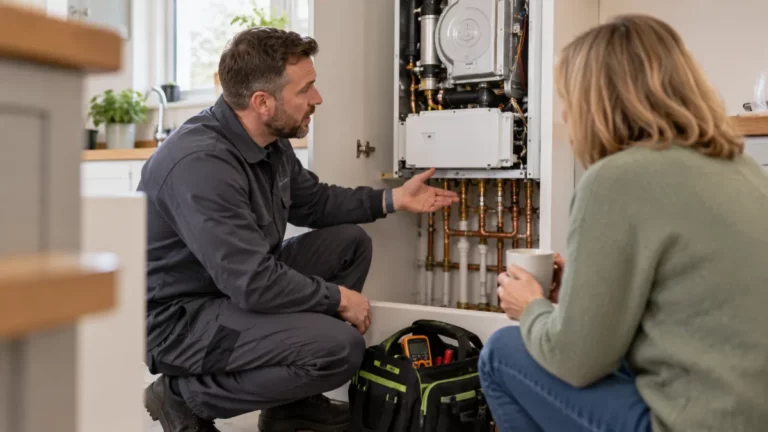
- If the cold supply is good but the hot flow is still poor, or the water keeps running hot then cold, the boiler’s hot water side may need checking.
Don’t open the boiler casing yourself. Work on a gas boiler should be left to a suitably qualified Gas Safe registered engineer. Our page on boiler repairs explains what’s involved.
A warning about pumps: Screwfix’s guide warns against fitting a shower pump to a combi or unvented system. Separately, the Water Supply (Water Fittings) Regulations 1999 require you to notify your water company and get its consent before fitting a pump or booster that draws more than 12 litres per minute from a supply pipe.
Low hot water pressure with a gravity-fed cylinder
In a vented system, hot water is pushed out of the cylinder by the weight of water in the cold tank above it. Mira Showers explains that the higher the cistern sits above the shower head, the more pressure you get, and gives a minimum height of 1 metre for showers. That’s why a top-floor shower, or a bathroom in a loft conversion close to the level of the tank, can be weak while the downstairs taps are fine.
Things worth checking:
- The loft tank: is it refilling properly? A sticking float valve can leave it low.
- Airlocks: taps that splutter after the water has been off can point to air in the pipes.
- Valves: the valve on the cold feed from the tank to the cylinder should be fully open.
On a gravity system the hot taps will often be gentler than the cold kitchen tap, because the kitchen tap is usually fed straight from the mains. That on its own isn’t a fault. If you’d like a stronger shower, options include a shower pump designed for gravity-fed systems, fitted by a plumber, or changing to a different hot water system. Worcester Bosch notes that pump-assisted power showers may not suit a combi, so if you’re thinking of switching, check what your showers need first.
Low hot water pressure with an unvented cylinder
An unvented cylinder runs at mains pressure, so it normally gives a strong flow at every tap. If the flow drops, rule out the mains supply first, using the checks above. The cylinder’s own inlet controls can also affect flow. These include safety-critical parts, so they should only be checked or adjusted by an installer qualified to work on unvented systems, normally as part of an annual service. Our guide to unvented hot water cylinder servicing explains more.
When the problem is the water supply
Water companies have a minimum standard. WaterSafe says the guaranteed minimum is 7 metres static head (0.7 bar), measured where the water leaves the supplier’s pipework, usually at the outside stop valve or property boundary, and that suppliers aim for at least 10 metres head (about 1 bar). United Utilities says there should be 10 metres head of pressure at the boundary, with a flow of 9 litres per minute.
CCW notes that the water company isn’t responsible for the pressure in your own private pipes. If your checks suggest the supply itself is weak, contact your water company and ask whether there’s a known problem in your area or whether it can test the pressure at your property. For homes in Greater Manchester, that’s usually United Utilities.
Low hot water pressure in Greater Manchester homes
Homes across Greater Manchester have every kind of hot water system, from cylinders with loft tanks to combis and unvented cylinders, and many have been altered over the years. Because the cause depends so much on the system, the most useful thing you can tell an engineer is which type you have, whether the cold kitchen tap is also weak, and whether the problem affects every outlet or just one.
When to call an engineer or plumber
- Your cold supply is fine but the hot water flow is still poor.
- The hot water runs hot then cold, or the boiler shows a fault code.
- You’ve found a leak, or the loft tank isn’t refilling.
- Water is running from the safety pipework (the tundish) on an unvented cylinder.
- You want to improve things, such as a shower pump on a gravity system or a change of hot water system.
Leaks, valves and pipework are usually a job for plumbing repairs. Anything inside a gas boiler needs a Gas Safe registered engineer.
If there’s no hot water at all, rather than weak flow, see our guide to what to check when your boiler is not working.
FAQs
Why is my hot water pressure low but the cold is fine?
On a gravity-fed system that’s often normal, because the hot water comes from a loft tank while the cold kitchen tap is usually fed from the mains. On a combi or unvented system, where both come from the mains, good cold but weak hot suggests the boiler or cylinder needs checking by an engineer.
Can I fit a shower pump to a combi boiler?
No. Shower pumps are designed for gravity-fed systems, and Screwfix’s guide warns against fitting them to combi or unvented systems. Under the Water Supply (Water Fittings) Regulations 1999, a pump or booster drawing more than 12 litres per minute from a supply pipe also needs your water company’s consent.
Does the pressure gauge on my boiler affect the pressure at my taps?
No. The gauge shows the pressure in the sealed heating circuit, not the water at your taps. If the heating pressure falls too low, though, the boiler may stop working, which can mean no hot water at all from a combi.
Why does my shower go weak when someone uses another tap?
The supply is being shared between outlets. Which? notes that a combi’s flow reduces when two or more outlets are in use, and CCW lists a shower losing flow when other water is used as one sign of low pressure.
Will a new boiler fix low hot water pressure?
Not necessarily. A combi can’t deliver more water than the mains supplies, so if the incoming supply is the limit, a new or more powerful combi may not help. It’s worth having the mains pressure and flow measured before choosing a replacement.
Who should I contact about low mains water pressure?
Your water company, which for most of Greater Manchester is United Utilities. Pipework on your side of the boundary is generally your responsibility, so it’s worth doing the checks above first.
Still struggling with weak hot water? Find out more about hot water system repairs and upgrades, or tell us what you need for a free, no-obligation quote, and a local heating engineer will get back to you.