Is It Cheaper to Leave the Heating on Low All Day?
Quick answer
If you have a gas or oil boiler, leaving the heating on low all day usually costs more than heating your home only when you need it. The Energy Saving Trust says keeping the heating on all the time uses more energy. Heat pumps are the main exception: they run more efficiently when left on with a small temperature set-back.
- Boiler: use a timer, coming on about half an hour before you get up.
- Heat pump: keep it on and lower the temperature a few degrees at night.
- Set the thermostat to the lowest comfortable temperature, 18°C to 21°C for most people.
- Turning the thermostat up won’t heat your home any faster.
- In a cold spell or when you’re away, keep the heating on low so pipes don’t freeze.
It’s one of the most common heating questions every winter: is it cheaper to leave the heating on low all day, or to put it on only when you need it? For most homes with a gas or oil boiler, the evidence points one way. Heat pumps and a few other set-ups are different, though, so the right answer depends on what heats your home.
This guide explains why, sets out the exceptions, and shows how to set your timer, thermostat and boiler so you stay warm without paying to heat an empty house.
Why leaving the heating on low all day usually costs more
If you have a boiler, the Energy Saving Trust’s answer is no: keeping the heating on all the time uses more energy and costs more money.
Your home is always losing heat through its walls, roof, windows and floors. How fast it loses heat depends on the difference between the temperature inside and the temperature outside. The warmer you keep the house, the faster heat escapes, and the boiler has to replace it.
When the heating goes off, the house starts to cool. As it cools, it loses heat more slowly. When the heating comes back on, the boiler has to put back the heat that was lost, but that’s less than it would have used keeping the house warm the whole time. So the popular idea that heating a house from cold uses more energy than keeping it ticking over doesn’t hold up for a boiler. Worcester Bosch makes the same point: it’s cheaper to use the heating only when you need it, whether the energy is trickling out all day or used in shorter bursts.
Timing matters too. The Energy Saving Trust uses about 30 minutes as a rule of thumb for an average house to heat up or cool down, although yours may take more or less time depending on its size, insulation and heating system. As a starting point, it suggests setting the heating to come on around half an hour before you get up and to go off around half an hour before you go to bed. Better insulation helps a home warm up faster and cool down more slowly.
When is it better to leave the heating on?
The answer isn’t the same for every home. These are the main exceptions.
Heat pumps
The Energy Saving Trust advises keeping a heat pump on all the time and using a “set-back”, which means lowering the target temperature by a few degrees overnight or during the day rather than switching the system off. Running for longer at a lower flow temperature doesn’t increase overall running costs, because the heat pump works more efficiently that way. If the house is allowed to cool a lot, the heat pump has to work harder to bring it back up. The best schedule still depends on the system, your tariff and the property, so ask your installer how yours should be set up.
Leaving a heat pump on doesn’t mean running it at full comfort temperature through the night. Heat pumps work less efficiently when it’s very cold outside, so the same guidance advises against scheduling extra heating or hot water overnight in cold weather, unless you’re on a time-of-use tariff with cheaper night-time electricity. A small set-back lets it tick over at a lower temperature instead. Our guide to heat pump running costs explains how efficiency, tariffs and flow temperature affect your bills.
If you’re thinking of switching, our page on air source heat pump installation explains what’s involved.
Condensing boilers and lower flow temperatures
A modern condensing boiler is more efficient when the water it sends round the radiators (the flow temperature) is cooler. Nesta, the innovation charity, says many boilers are set to 70°C to 80°C, and it recommends 60°C or lower for combi boilers. If you have a separate hot water cylinder, Nesta suggests lowering the radiator flow temperature only as far as 65°C. That’s the heating setting, not the temperature of the stored hot water: leave the cylinder’s hot water setting as your installer set it, because stored hot water needs to be kept hot enough to control legionella bacteria.
Nesta estimates that turning the flow temperature down from 80°C to 60°C could cut a household’s total gas use by about 9%. That figure is based on tests at the Salford Energy House, where gas used for heating fell by 12%, and assumes heating is about three-quarters of a home’s gas use. The same tests found the house took 17 minutes longer to warm up, so Nesta suggests setting the heating to come on 15 to 30 minutes earlier.
That’s a reason to let the heating run a little longer at a lower temperature, not a reason to leave it on all day. If you change the flow temperature and some rooms no longer get warm enough in very cold weather, turn it back up a little. Your boiler manual will show you where the setting is.
Underfloor heating
Wet underfloor heating warms up and cools down slowly, so it’s usually run on a steadier schedule with a smaller drop in temperature than radiators. Our guide to wet vs electric underfloor heating covers how each type works.
If you’re planning a new floor, our underfloor heating installation page explains the options.
If someone is at home most of the day, the house needs heating for most of the day anyway. In that case, programme the heating around the hours the rooms are used, and let it drop a little overnight.
Some heating specialists argue that slower, steadier heating suits homes with heavy brick walls or well-insulated homes with a low flow temperature. The honest picture is that it depends on the building, the system and how you use it. If you’re unsure, test both ways in your own home (see below).
Electric heating
Direct electric heaters, such as panel heaters and fan heaters, turn electricity into heat at much the same rate whether they run for one hour or ten. There’s no efficiency gain from leaving them on low, so heat the rooms you’re using, when you’re using them. Electric storage heaters work differently: they charge overnight on cheaper electricity, so follow the controls guidance for your model.
Which heating schedule is cheapest?
| Heating system | Leave it on low all day? | What usually works better |
|---|---|---|
| Gas, LPG or oil boiler | Usually costs more | A timer and room thermostat, plus a lower flow temperature on a condensing boiler |
| Heat pump | Generally yes, with a set-back | Keep it on and drop the temperature a few degrees at night or when you’re out |
| Wet underfloor heating | Often run on a steadier schedule | Longer heating periods with a small set-back |
| Direct electric heaters | No efficiency gain | Heat the rooms you use, when you use them |
| Any system in freezing weather, or when you’re away | Keep some heat on | A low setting so pipes don’t freeze |
What temperature should you keep your home at?
Saving energy shouldn’t mean living in a cold home. The UK Health Security Agency advises heating the rooms you spend a lot of time in, such as the living room and bedroom, to at least 18°C if you can. It says low indoor temperatures can have a serious effect on health, particularly for older people, young children and people with long-term health conditions.
The Energy Saving Trust suggests most people set their thermostat somewhere between 18°C and 21°C, and that keeping warm is especially important for older people and anyone with a medical condition.
Damp and condensation
The UK Health Security Agency notes that when a home is both damp and cold, mould is more likely. Condensation forms when moist air meets a cold surface, such as a window or an outside wall, and it tends to build up in the colder parts of a house. Heating alone won’t solve it: the Energy Saving Trust’s advice is to ventilate so moist air can escape, use extractor fans when cooking, showering or bathing, keep window vents open, and leave gaps between furniture and walls. If damp keeps coming back, it’s worth finding the cause.
Cold snaps, frozen pipes and going away
There is one time when keeping the heating on low is sensible for any system: freezing weather. United Utilities, the water company for the North West, advises keeping the central heating on low during a cold spell to help stop pipes freezing, and making sure the heating comes on if you’re away. This reduces the risk rather than removing it: pipes in lofts, garages, outbuildings and on outside walls can still freeze, so lag exposed pipework and make sure you know where your stopcock is.
Many boilers also have a frost protection setting, but it can only work if the boiler has power and fuel, so leave it switched on. Check your manual to see how yours works. In very cold weather, a frozen condensate pipe can also stop a condensing boiler working. Our guide to a frozen condensate pipe explains how to spot it and thaw it safely.
How to reduce your heating bills
If you have a boiler, these settings make the biggest difference without leaving you cold.
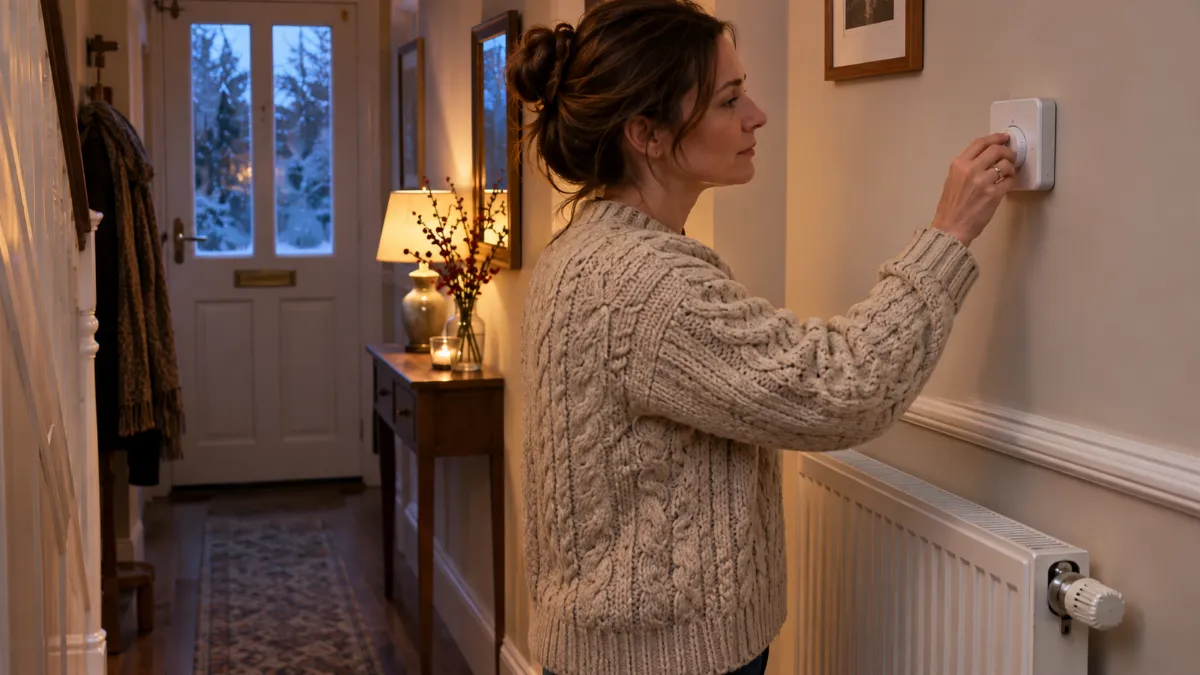
- Use the timer. Set the heating to come on about half an hour before you get up and go off about half an hour before bed, and switch it off when everyone’s out. Check the programmer’s clock is right, especially after the clocks change or a power cut.
- Set the room thermostat to the lowest comfortable temperature. For most people that’s 18°C to 21°C, according to the Energy Saving Trust.
- Don’t turn the thermostat up to warm the house faster. It won’t heat up any quicker; it will just keep heating to a higher temperature. You also don’t need to turn it up when it’s colder outside.
- Use your radiator valves. Thermostatic radiator valves are usually numbered, but the scale varies by make. On a valve marked 0 (off) to 6 (fully open), the Energy Saving Trust suggests around 3 to 4 for rooms you use a lot and 2 to 3 for bedrooms and rooms you use less. Aim for the lowest setting that keeps each room comfortable.
- Look at the flow temperature. On a condensing boiler, a lower flow temperature can cut gas use, as explained above.
- Heat hot water only when you need it. If you have a well-insulated hot water cylinder, water heated in the morning may still be hot enough in the evening.
- Keep the boiler serviced. An annual boiler service helps it run safely and efficiently and can pick up developing faults early.
If you’re thinking about a new system, our guide to combi vs system vs regular boilers explains how each type heats your home and water.
When you’re ready to compare prices, our new boiler installation page sets out the options and typical 2026 UK price ranges.
How to test which heating schedule costs less
If you want to be sure, try both approaches. MoneySavingExpert suggests running the heating one way for a week or so, then the other way, and comparing your meter readings. Keep the rest of your routine the same, and remember that colder or milder weather can skew the results. A smart meter’s in-home display makes it easier to see the difference day by day.
Heating advice for Greater Manchester homes
Homes across Greater Manchester range from Victorian and Edwardian terraces to inter-war and post-war semis, newer estates and city-centre apartments, and that mix affects how well a home holds its heat. Government guidance says homes built before about 1920 probably have solid walls, while later homes probably have cavity walls, and that around a third of the heat in an uninsulated home is lost through the walls.
An older house with uninsulated solid walls may cool down faster once the heating goes off, so a timer with a sensible warm-up period matters more. A newer or well-insulated home holds its heat for longer, so the heating can often switch off a little earlier without the rooms getting cold. Either way, the same rule applies: heat the rooms you use, when you use them, at a temperature that keeps you well.
If you rent, report any heating fault to your landlord.
When to call a heating engineer
If your home won’t reach the temperature on the thermostat, some radiators stay cold, or the boiler keeps switching on and off, the problem may be the system rather than your settings. It may need central heating repairs, such as balancing the radiators or replacing a faulty valve, or boiler repairs if the boiler itself is at fault. Our guides to radiators cold at the top or bottom and a boiler not working cover the checks you can make first. Work on a gas boiler should be left to a suitably qualified Gas Safe registered engineer, and work on an oil boiler to a suitably qualified technician, such as one registered with OFTEC.
Heating bills still too high?
If your bills still seem high after you’ve adjusted your thermostat, timer and radiator valves, your boiler or heating system may not be running as efficiently as it should. A boiler that keeps switching on and off, radiators that never fully heat up, or controls that don’t respond properly can all waste energy.
Manchester Heating Experts helps homeowners and landlords find a heating engineer covering their part of Greater Manchester to look at boilers, radiators and heating controls. Request a free, no-obligation quote, and agree the price with the engineer before any work starts.
Frequently asked questions
Is it cheaper to leave the heating on low all day?
Not if you have a boiler. The Energy Saving Trust says keeping the heating on all the time uses more energy and costs more, so a timer and room thermostat are the cheaper way to stay warm. Heat pumps are the main exception: they’re more efficient left on with a small set-back.
Does turning the thermostat up heat the house faster?
No. The heating warms the house at the same rate whatever the thermostat says; a higher setting just means it keeps going until the house is warmer. Set it to the temperature you want and leave it.
What temperature should I set my thermostat to?
The Energy Saving Trust suggests the lowest temperature you’re comfortable at, which for most people is between 18°C and 21°C. The UK Health Security Agency advises heating the rooms you use most to at least 18°C if you can, especially if you’re older, have young children or have a long-term health condition.
Should I leave my heat pump on all the time?
Generally, yes. The Energy Saving Trust advises keeping a heat pump on and lowering the temperature by a few degrees overnight or when you’re out, rather than switching it off. Ask your installer to check the heating curve (weather compensation) and flow temperature are set correctly.
Should I leave the heating on when I go away in winter?
Yes, on a low setting. United Utilities advises keeping the central heating on low in a cold spell and making sure it comes on while you’re away, to help reduce the risk of frozen pipes. Lag any exposed pipes too, and leave the boiler’s power switched on so any frost protection can work.
Will leaving the heating on low stop condensation and damp?
It can help to keep rooms reasonably warm, as condensation forms on cold surfaces, but ventilation matters just as much. Use extractor fans, keep window vents open and leave gaps behind furniture. If damp or mould keeps coming back, find out what’s causing it.
Sources
This guide is based on the following published advice, checked in November 2026.
- Energy Saving Trust: When should I put my heating on?
- Energy Saving Trust: The most economical ways to use your central heating
- Energy Saving Trust: Heating controls
- Energy Saving Trust: The most efficient way to run a heat pump
- Energy Saving Trust: How to get rid of damp
- Nesta: Boiler campaign evidence summary (PDF)
- UK Health Security Agency: Top tips for keeping warm and well this winter
- United Utilities: Don’t lag behind when it comes to protecting your pipes
- Worcester Bosch: Is it cheaper to keep the heating on all day?
- MoneySavingExpert: Energy-saving myths
- GOV.UK (DECC): Wall insulation factsheet (PDF)