Boiler Not Working? No Heating or Hot Water Checks to Try First
Quick answer
If your boiler has stopped working, a few simple checks can help you find the cause. Problems with the power, the gas supply, the timer or the system pressure can all stop a boiler from firing. If the checks don’t fix it, work on a gas boiler should be left to a suitably qualified Gas Safe registered engineer.
- If you smell gas, leave the property and call 0800 111 999 from outside.
- Check the boiler has power, including the fused spur and the fuse box or consumer unit.
- Check the pressure gauge: many boilers sit at around 1 to 1.5 bar when the system is cold.
- Check the timer, programmer and room thermostat are calling for heat.
- Reset the boiler only once, and only as your manual describes.
If your boiler has stopped working and you have no heating, no hot water, or neither, a few simple checks can help you find the cause. Problems with the power, the gas supply, the timer or the system pressure can all stop a boiler from firing, and some of these you can sort out yourself without touching the boiler’s internal parts. If these checks don’t fix it, the next step is usually a boiler repair.
This guide covers the safe checks to try first, what it can mean when you have heating but no hot water (or the other way round), and when it’s time to call a Gas Safe registered engineer.
Safety first: when not to troubleshoot
Stop and get help straight away if any of these apply:
- You can smell gas. Turn off the gas at the emergency control valve next to your meter if it’s safe to do so (don’t go near a meter in a cellar or basement). Open doors and windows, don’t use electrical switches or anything that could make a spark or flame, leave the property and call the National Gas Emergency number on 0800 111 999 from outside.
- Your carbon monoxide alarm goes off, or you have symptoms such as headaches, dizziness or nausea that ease when you leave the house. Get everyone into fresh air, turn the appliance off only if you can do so safely without delay, call 0800 111 999 and get urgent medical advice. Call 999 if someone is seriously unwell.
- Water is leaking onto or near the boiler’s electrics. Switch off the electricity supply to the boiler if it’s safe to do so, and arrange an engineer.
Never remove the boiler’s casing or try to repair internal parts yourself. Work on a gas boiler should be left to a suitably qualified Gas Safe registered engineer.
No heating or hot water: the quick checks
Work through these in order. Most take a minute or two and need nothing more than your boiler manual.
1. Is there power to the boiler?
Check whether the boiler’s display or lights are on. If they’re blank, look at the switch or fused spur that feeds the boiler (usually on the wall nearby) and check your fuse box or consumer unit for a tripped switch. If the whole street has lost power, you can report it or get updates by calling 105, the free national power cut number, which puts you through to your local electricity network operator.
After a power cut or a tripped switch, check the boiler’s clock and programmer, as the times may have been reset.
2. Is the gas supply on?
Try another gas appliance, such as a gas hob or gas fire. If that won’t light either, the problem is likely to be the gas supply rather than the boiler.
- Prepayment meter: check you have credit. If you’ve run out, you may be able to use emergency credit, which Citizens Advice says is usually around £10 and is paid back when you next top up. Your supplier can tell you how to access it on your meter.
- Emergency control valve: check the lever next to your gas meter hasn’t been knocked into the off position.
- Supply problem: if you have credit and nothing gas-fired will work, contact your gas supplier. If you smell gas at any point, follow the safety steps above.
3. Check the boiler display for a fault code
Most modern boilers show a code or a warning light when something has gone wrong. Note it down, then look it up in your boiler manual or on the manufacturer’s website. Codes vary by make and model, and the same code can have more than one cause. Our brand pages list some common codes for the main boiler brands, as a guide only.
Many boilers have a reset button. If the manual says a reset is suitable for that code, you can try it once. If the boiler locks out again, don’t keep resetting it: repeated lockouts are a sign of a fault that needs an engineer.
4. Check the boiler pressure
Sealed central heating systems (most combi and system boilers) have a pressure gauge on or under the boiler. If the pressure drops too low, many boilers will stop working to protect themselves. As a general guide, many boilers sit at around 1 to 1.5 bar when the system is cold, but the right range can vary by model, so check your manual.
If the pressure is low, you may be able to top it up using the filling loop or key, following the manufacturer’s instructions. If you need to top it up more than occasionally, there may be a leak or a faulty part. Our guide to a boiler losing pressure covers the checks in more detail.
5. Check the timer, programmer and thermostat
Controls are one of the first things to check, especially at the start of the heating season or after the clocks change.
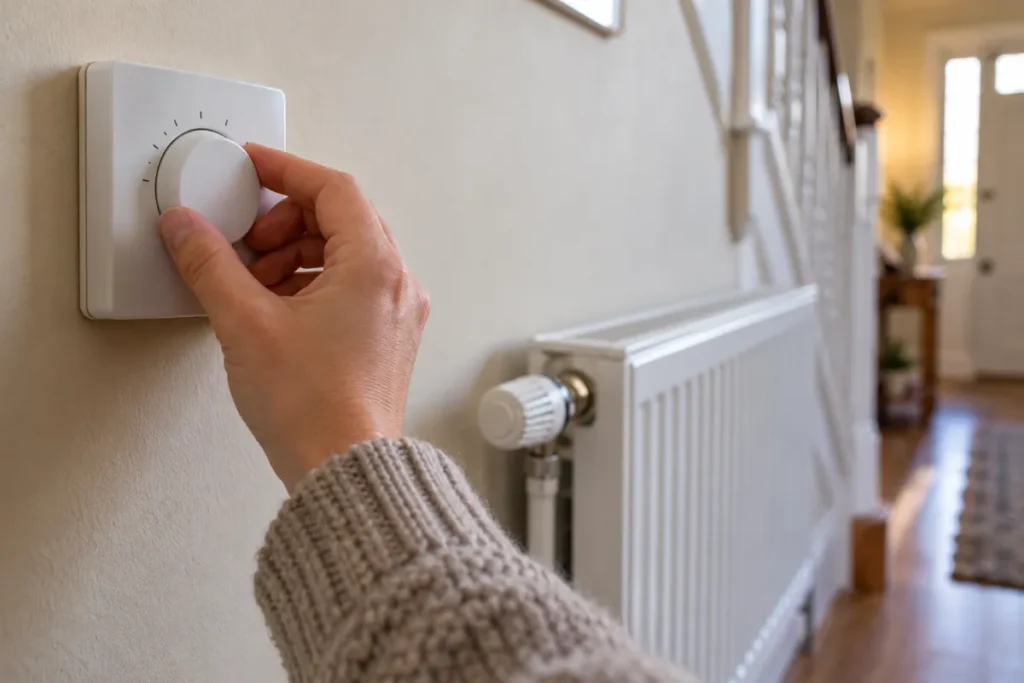
- Timer or programmer: make sure it’s set to an “on” period, the clock shows the right time and day, and the boiler is set to provide heating and hot water (not hot water only, or holiday mode).
- Room thermostat: turn it up above the current room temperature (for example to 21°C) and listen for the boiler firing. If it’s a wireless or battery-powered thermostat, try fresh batteries.
- Smart controls: check the app isn’t in an away, eco or holiday mode, and that the thermostat is still connected to its hub or the boiler.
- Boiler temperature dials: make sure the heating and hot water settings on the boiler itself haven’t been turned right down.
6. In cold weather, check the condensate pipe
Condensing boilers have a plastic condensate pipe that carries waste water to a drain. If part of it runs outside, it can freeze in a cold snap, and the boiler may then stop working and show a fault code. You may also hear a gurgling noise. Our guide to thawing a frozen condensate pipe safely explains what to do. If the weather is mild, this is unlikely to be the cause.
7. Is your water supply on?
If no water at all comes out of your cold taps, the problem may be the mains supply rather than the boiler. A combi boiler can’t make hot water without a cold mains supply. Check whether your stopcock has been turned off, and check your water company’s website for supply interruptions in your area.
Heating works but there’s no hot water
If your radiators heat up but the taps run cold, the cause depends on the type of system you have.
Combi boilers
A combi heats water on demand, using a diverter valve to switch between the heating and the hot taps. If this valve sticks or develops a fault, you may get heating but no hot water. You can’t fix a diverter valve yourself, so you’ll need a Gas Safe registered engineer. Before you call, check that the boiler’s hot water temperature setting hasn’t been turned down and that the cold mains supply is on.
If you have hot water but it’s coming through weakly, see our guide to low hot water pressure.
System and regular boilers with a cylinder
If your hot water is stored in a cylinder, check:
- the programmer is set to heat the hot water as well as the heating, during the times you need it
- the cylinder thermostat (often a small dial strapped to the side of the cylinder) hasn’t been turned down
- whether you have an immersion heater, which some households use as a back-up to heat the cylinder by electricity while the boiler side is being repaired
If the controls are set correctly and the cylinder still doesn’t heat, the fault may be with a motorised valve, the pump or the cylinder controls, which are jobs for an engineer. Unvented (mains-pressure) cylinders have safety devices that should only be checked by a suitably qualified installer. Our guide to unvented hot water cylinders explains more.
Hot water works but there’s no heating
If the taps run hot but the radiators stay cold, try these checks:
- Turn the room thermostat up and check the programmer is set to heating, not hot water only.
- Check the radiator valves and thermostatic radiator valves (TRVs) are open. TRVs that have been shut all summer can sometimes stick; turning them fully up and down a few times may free them.
- If the radiators are warm at the bottom but cold at the top, there may be air in the system. Our guide to radiators cold at the top or bottom explains how to bleed them, and what it means if they’re cold at the bottom instead.
- Check the boiler pressure again after bleeding, as it can drop.
If the controls are calling for heat and the radiators still don’t warm up, the fault may be with the pump, a motorised valve, the diverter valve (on a combi) or the thermostat itself. These need an engineer to diagnose.
At a glance: symptom and what to check
| What’s happening | What it can mean | What you can check |
|---|---|---|
| Boiler display is blank | No power to the boiler | Fused spur, fuse box, power cut (call 105) |
| Boiler won’t light, gas hob won’t light either | Gas supply problem | Prepayment credit, emergency control valve, gas supplier |
| Fault code or warning light | The boiler has detected a fault and locked out | Look up the code in the manual; reset once only if the manual allows |
| Pressure gauge low | Water has been lost from the system | Top up if your manual allows; call an engineer if it keeps dropping |
| Boiler powered but not firing | Controls not calling for heat | Timer, clock, thermostat setting and batteries |
| Fault code in freezing weather, gurgling sound | Frozen condensate pipe | Thaw the outside pipe with warm (not boiling) water |
| Heating works, no hot water | Diverter valve (combi) or cylinder controls (system/regular) | Hot water settings, programmer, cylinder thermostat |
| Hot water works, no heating | Controls, closed or stuck valves, air, or a pump or valve fault | Thermostat, programmer, TRVs, bleeding radiators |
When to call a Gas Safe engineer
Call an engineer if:
- the boiler keeps locking out, or shows the same fault code after one reset
- the pressure keeps dropping, or you can see water leaking from the boiler or pipework
- you’ve checked the power, gas, controls and pressure and the boiler still won’t fire
- you suspect a diverter valve, pump, motorised valve or other internal fault
- the boiler is making new or unusual sounds (our guide to boiler noises explains what they can mean)
When you call, it helps to have the boiler’s make and model, any fault code, the pressure reading and a short description of what is and isn’t working. This can help the engineer bring the right parts.
If you rent your home, report the problem to your landlord or letting agent. Landlords are responsible for repairs to the heating and hot water, and for the yearly gas safety check.
If someone in your home is vulnerable
Losing heating can be serious for older people, young children, and anyone who is disabled or unwell. Your energy supplier and your gas and electricity network operators each run a free Priority Services Register, which can give extra support during supply problems and emergencies. It’s worth checking you’re registered if you’re eligible.
Can you stop it happening again?
Not every breakdown can be prevented, but some steps can help:
- Have an annual boiler service. A service checks the boiler is working safely and can spot developing faults. Many boiler warranties also require annual servicing in line with the manufacturer’s terms.
- Turn the heating on for a short spell before the cold weather arrives, so any problems show up before you really need it.
- Keep an eye on the pressure gauge and note what’s normal for your boiler.
- Make sure any outside section of the condensate pipe is suitable for cold weather.
If your boiler is older and breaking down more often, our guide to how long boilers last can help you decide whether repair or replacement makes more sense.
No heating in Greater Manchester
The checks above apply wherever you live. In Greater Manchester, as elsewhere, problems often come to light in autumn, when the heating is switched on for the first time after the summer, and during cold snaps, when outside condensate pipes can freeze. If you’ve worked through the checks and the boiler still isn’t working, heating engineers covering all 10 Greater Manchester boroughs carry out boiler repairs on all the main makes.
Once it’s working again, our guide on whether it’s cheaper to leave the heating on low all day explains how to set your timer and thermostat to keep running costs down.
Frequently asked questions
Why is my boiler on but not heating the house?
If the boiler has power but the radiators stay cold, the controls may not be calling for heat. Check the programmer is set to heating, the clock is correct and the room thermostat is set above the current temperature. If they are, the problem may be air in the system, closed radiator valves, low pressure, or a fault with the pump or a valve.
Should I reset my boiler?
If your manual says a reset is suitable for the fault shown, you can try it once. If the boiler locks out again, don’t keep resetting it. Repeated lockouts point to a fault that needs a Gas Safe registered engineer.
What pressure should my boiler be at?
As a general guide, many boilers sit at around 1 to 1.5 bar when the system is cold, but this can vary by model, so check your boiler manual. If it keeps dropping, there may be a leak.
Why do I have heating but no hot water from my combi?
One of the first things to check is the hot water temperature setting and the cold mains supply. If both are fine, a stuck or faulty diverter valve can send hot water to the radiators instead of the taps. This needs a Gas Safe registered engineer to diagnose and repair.
Can I fix my boiler myself?
You can safely check the power, gas supply, controls, pressure and condensate pipe, and follow the steps your manual describes. Anything inside the boiler casing, or any work on the gas supply, should be left to a Gas Safe registered engineer.
My boiler stopped working after a power cut. What should I do?
Check the boiler has power and look at the clock and programmer, as the times may have reset. If there’s a fault code, follow your manual’s advice. If the boiler still won’t restart, contact an engineer.
Still no heating or hot water? Tell us what’s happening for a free, no-obligation quote.